Posts

Chafariz das Janelas Verdes, Lisbon, Portugal

Image
The Fountain of Janelas Verdes is located close to the National Museum of Ancient Art, in Largo José Figueiredo. The new fountain demanded a new square and they were both planned by architect Reinaldo Manuel dos Santos. The fountain was one of a group of eighteen fountains connected to the Aqueduct , that supplied water to Lisbon. The Baroque fountain, built in 1755, is crowned by a statue of the goddess Venus with the Cupid (symbolizing love) and a dolphin (symbolizing water). How to go: Rua das Janelas Verdes buses 713, 714, 727 ; Av. 24 de Julho buses 728, 732, 760 and trams 15E, 18E. 

House of Santa Maria and Lighthouse of Santa Marta, Cascais, Portugal

Image
The house of Santa Maria, built in 1902, was designed by the Portuguese architect Raul Lino, one of his first works. It was ordered by Jorge O' Neill, a Portuguese businessman of Irish ascendancy, but sold to the architect's brother in 1918, who added 18th-century tiles and a painted wooden ceiling brought from a chapel in Frielas. The house was again sold in 1925 to the Espírito Santo family and in 2004 to the city council. The lighthouse museum of Santa Marta opened to the public in 2007. It has two main exhibitions, one on Portuguese lighthouses and a second one on the lighthouse of Santa Marta. The lighthouse is located in a fort, probably dating from the Restoration Wars, in the 17th century. The lighthouse was built two centuries later, in 1868, and is about 20m tall. Opening hours: Tue.to Fri. 10h to 17h, Sat. and Sun. 10h to 13h and 14h to 17h; The lighthouse tower Tue. to Fri., 11h to 12h, Sat. and Sun. 11h to 13h. Entrance fee: €4 ...

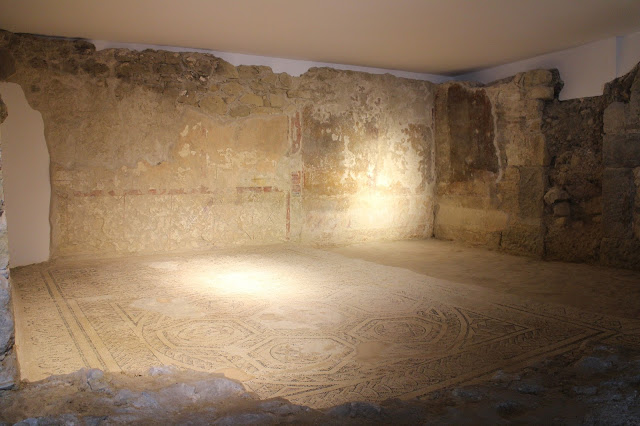
Hotel Eurostars Museum archaeological ruins, Lisbon, Portugal

Image
The Hotel Eurostars Museum is located in the old Palace of Coculim, which was built in the 16th century but was mostly destroyed by the 1755 earthquake. Whatever was left after the earthquake was destroyed by the successive uses given to the palace and from its origins only some Mannerist features and the coat of arms of the Counts of Coculim, in the corner, remain. However, the hotel's historical interest has deeper roots, as it is located on top of an area with over 8 thousand years of history, starting in the Neolithic Period. This area has been studied for a few decades and the results are exhibited in the hotel. One of the most important findings was a Phoenician  stele  because it showed that there were already Phoenician colonies on the Atlantic Coast during the Iron Age and these resulted not only in trading but also in acculturation, as the names on the stele are local names. In one of the exhibition areas are the remains of a Roman domus , including a mos...

Ribeira Beach, Cascais, Portugal

Image
Ribeira Beach is located in the centre of Cascais, close to the main square. It is named after Ribeira de Vinhais (a stream) which flows into the ocean in this beach. It is mainly used for fishing activities and there are a small dock and pier. It is thus also known as "Fishermen's beach". Although it isn't destined for bathing, the water quality is good and monitored regularly and the beach is supervised by a lifeguard during the bathing season. It is located about five minutes from the train station and can be crowded during the high season, particularly on weekends.

Fronteira Palace, Lisbon, Portugal

Image
Fronteira Palace started being built in 1670, right after the Restoration War, due to which D. João de Mascarenhas became the Marquis de Fronteira as a reward for his military feats. The Palace was initially a Hunting Pavilion and a Summer Residence but after the main residence, more close to Lisbon was destroyed by the 1755 earthquake, it became the seat of House Fronteira. The Palace was not affected by the earthquake due to the basaltic soil it stands on but after it became the family's main residence the Palace was significantly enlarged and renovated. Fronteira Palace is located close to Monsanto Park and is classified as a national monument since 1982, including the gardens, a chapel, a gallery with all the Portuguese monarchs- except the Spanish dynasty against which the Marquis de Fronteira went to war- and a small pavilion with a water tank. It is said that this pavilion is decorated with the pieces of broken plates used in a banquet held for king D. Pe...