Posts

Showing posts with the label Portugal

Vila Viçosa, Portugal

Image
Vila Viçosa was founded during the reign of King D. Afonso III, who granted it a charter in 1270. Later it was gifted to Portugal's Constable, D. Nuno Álvares Pereira, for his role in the Battle of Aljubarrota, which was determinant for the kingdom's independence. During the reign of King D. Manuel I the town became the seat of the House of Bragança, descendants of D. Nuno who had been exiled from the country by the previous king, due to their influence and wealth. The town was granted a new charter in 1512. The Duke of Bragança eventually ordered a palace to be built as the old medieval castle had been remodelled to be used exclusively for military purposes and was thus an uncomfortable residence. During the Spanish rule, Vila Viçosa was the seat of the largest ducal court of the Iberian Peninsula. In 1640 the Duke of Bragança declared the independence of Portugal from Spain and became the first king of the fourth dynasty. He consecrated the crown of Portugal t...

National Palace and Gardens of Queluz, Portugal

Image
The National Palace of Queluz was built in 1747, in the late Baroque and Rococo styles, by order of the future king Pedro III, married to queen Maria I. It was conceived as a Summer residence, becoming the royal family's favourite place for leisure and entertainment. Following a fire in the National Palace of Ajuda, Queluz became their permanent residence, until 1807, when the royal family had to flee to Brazil to escape the French Invasions. Despite being much smaller, the palace is sometimes dubbed the Portuguese Versailles. In 1908 it became the property of the State. It was extensively restored after a fire destroyed it in 1934. The complex makes a pleasant half day excursion from Lisbon. Opening hours: 9 a.m. to 7 p.m. Entrance fee: €10 How to get there: From Lisbon, the easiest way is to take the train, at Oriente, Entrecampos or Rossio, to Queluz or Monte Abraão. It's a 30 min. ride plus a 15 min walk to the palace. Charge your card with €5 for the roun...

Tavira, Portugal

Image
In the 8th century Tavira, then known as Ba'al Saphon, the Phoenician thunder and sea god, was one of the first Phoenician settlements in Western Iberia. The settlement was destroyed by conflict in the 6th century BC and abandoned. Remains of the Phoenician walls can be seen close to the Tourist office. During Roman rule, a new port was created some 7 km from Tavira. It was named Balsa and prospered and decayed in parallel with the Roman Empire. Tavira was then a passing place between Balsa and Baesuris (Castro Marim), important only for its bridge. Tavira was under Arab rule from the 8th to the 13th century. The Moors left their influence mainly on agriculture and architecture, which can still be seen today in the whitewashed buildings and Moorish style doors and rooftops. The toponym Tavira derives from the Arabic tabira, "the hidden". The city was reconquered by the Knights of the Order of Santiago in 1242 in retaliation for the killing of seven of their knights...

D. Ana Beach, Portugal

Image
Praia D. Ana is considered one of the most beautiful beaches in Portugal for its turquoise waters and natural cliffs. It is 2.5 km from Lagos city centre, a walk of about 30 minutes so it can get very crowded in Summer, particularly on the weekends. Parking is limited to about 70 vehicles but you can reach the beach either by bus ( Bus n.º 2  in Lagos) with a cost of about €1.20 or by taxi with a cost of about €10 round trip.

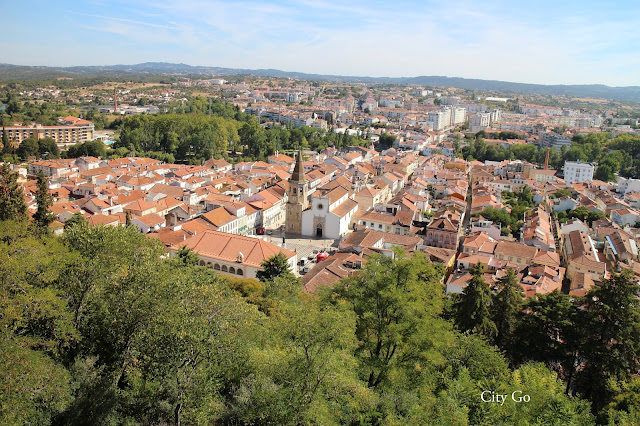
Tomar, Portugal

Image
The town of Tomar was established in 1159 on land granted to the Knights Templar by the first king of Portugal D. Afonso Henriques. At the time the Order was playing a crucial role in the reconquest of territory from the Muslims and in the formation of the new kingdom of Portugal. By order of Grand Master Gualdim Pais, in 1160 a Castle and a Convent started being built. Tomar would eventually become the headquarters of the Order in Portugal and local legend says that the choice was for mystical reasons and by divine inspiration. Also in 1160, the construction of the church of Santa Maria do Olival was ordered. Grand Master Gualdim Pais, as well as other twenty knights, are buried there. In 1312 King Philip the Fair ordered the arrest and execution of the Knights Templar in France. To keep the wealth of the Knights Templar in the country, King D. Dinis created the Order of Christ. He also persuaded the Pope to allow the fugitive Knights Templar to join the new Order. In 1418 He...

Roman Ruins of Milreu, Portugal

Image
The Roman villa in Milreu dates back to the 1st century AD. However, these initial constructions remain to be dug and most of what can be seen dates from the 3rd century AD. The villa is organised around a peristyle which would have 22 columns. It was decorated with mosaics depicting maritime motifs. In the 6th century, the pagan temple was converted into a Christian church. The premises were later used as a Muslim cemetery.It is likely that the site was only abandoned in the 10th century when the vaults of the religious monument collapsed. In the 16th century, a rural house was built; it is a unique example of the Algarvian civil architecture of the period. Opening hours : 9 a.m. to 1 p.m. // 2 p.m. to 5.30 p.m. (6.30 May to Sep) Entrance fee : €2 How to get there : From Faro, take bus 65 .

Braga, Portugal

Image
Evidence of human presence in the region dates back to the Neolithic period. During the Iron Age,  with the expansion of the "castro" culture and the Bracari, a Celtic tribe,  a series of "castros" (fortified settleme nts) were built. Bracara Augusta, the Roman city, was likely built on top of a major "castro",  destroyed due to the wars between the Bracari and the Roman army. The city was named both after the Celtic tribe and the emperor, to whom it was dedicated. During the Roman period, several public buildings were constructed, namely the theatre, the baths , and temples. In the 3rd century, when the province of Gaellecia was created, Bracara Augusta became its capital and by 385 it already had a bishopric and an important role in the Christianization of the Iberian Peninsula. With the fall of the western Roman empire, Bracara becomes the capital of the Suebi Kingdom and is later dominated by the Goths. From 715 the city is conquered and d...