Posts

Showing posts with the label Archaeological Museums

The National Archaeological Museum, Lisbon, Portugal

Image
The National Archaeological Museum is located in Belem, in the Monastery of the Hieronymites . It was founded by initiative of the famous Portuguese archaeologist José Leite Vasconcelos, in 1893. In 1903 it was installed in a segment of the Hieronymites rebuilt in the second half of the 19th century. Its main collection is Portuguese archaeology, from pre-historic times to the Middle Ages, including the Roman and Islamic periods. Also noteworthy are the Egyptian collection and the archaic jewellery collection kept in the museum's treasury. Opening hours: Tue. to Sun. 10 am to 6 pm Entrance fee: €5 or €12 together with the Monastery of the Hieronymites How to go: Tram 15 or buses 714, 727, 728, 743, 749, 751, 773, 729 Back to Lisbon

Museo Arqueologico de Arte Visigodo, Merida, Spain

Image
This small museum is located in Santa Clara Church, originally Merida's Archaeological Museum, inaugurated in 1838. After major excavations begun in 1910, the Roman collection increased significantly and had to be moved to more appropriate quarters, remaining only the Visigothic collection in the church. This collection includes items from the 4th to the 8th centuries when Merida was under the Visigothic rule. It includes mainly architectural elements.  Opening hours: 9.30 am to 8 pm (6.30 pm Oct. to Mar.); Entrance fee: €3 Back to Merida

Museum of Roman Antiquities, Rabat, Malta

Image
Located just outside Mdina, in a Roman townhouse from the 1st century BC, the museum contains artefacts from the Roman period including elegant mosaics and high-quality marble sculptures. In an annexe, there's a large collection of Muslim stelae from the Arab cemetery excavated on the site. The museum, built deliberately to protect the mosaics found on the site, was inaugurated in 1882. Opening hours: 9 am to 5 pm; Entrance fee: €6 Back to Mdina

Archaeological Museum of Chania, Greece

Image
The archaeological museum in Chania is housed in the former church of the Franciscan Monastery, built during the Venetian Period. During the Ottoman rule, the building was converted into a Mosque. After the Muslims left it was used as a cinema and, after World War II, as a military house. It became a museum in 1963 and underwent major restoration in the late 1970s. The museum's collections span from the Neolithic to the Roman Period and include findings from Chania and Western Crete. Opening hours: 8.30 am to 3 pm Entrance fee: €2 Back to Chania

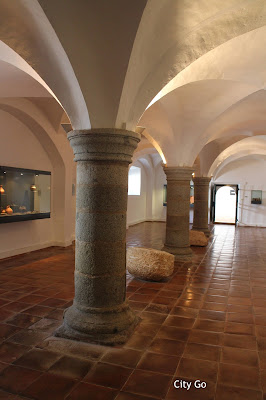
The Archaeological Museum, Vila Viçosa, Portugal

Image
The archaeological museum was inaugurated in 1999 to house the findings from excavations in the region, mainly from the Roman Period. The collection also includes materials resulting from the restoration of local patrimony. Opening hours: Tue. 14h-17h (18h Jun. Sep.); Wed.-Sun. 10h to 13h and 14h to 17h  (18h Jun. Sep.) Entrance fee: €3 (includes castle and hunting museum)

Archaeological Museum of Agios Nikolaos, Greece

Image
The Archaeological Museum of  Agios Nikolaos was founded in 1970 to house the numerous archaeological findings in Eastern Crete. The largest collection is a set of items excavated at Agia Photia cemetery near Sitia. It also houses part of the findings at Malia and Knossos Palaces. Unfortunately the museum seems to close periodically for refurbishment, which was the case on the day I visited. It is expected to reopen in 2018. Opening hours: Spring to Autumn, 8 a.m. to 3 p.m.; closed in Winter. Entrance fee: €4

National Museum of Roman Art, Merida, Spain

Image
The National Museum of Roman Art was inaugurated on September 9, 1986, specifically to house the Roman findings in the city. The building resembles the splendour of the Roman monuments and it mirrors Roman construction through modern architectural concepts and techniques. It was built with bricks specially manufactured for the museum. One of the features of the museum is the use of natural light to illuminate the items on display. The museum is built on top of Roman remains of houses and roadways, which can also be visited, in the museum's crypt. The creation of the first archaeological museum dates back to 1838 but it had to be re-evaluated, particularly after major excavations in 1910 and in the 1960s significantly increased its collections. The church of Santa Clara, the original premises of the museum, still houses the Visigothic collection. Opening hours: 9.30 a.m. to 8 p.m. (6.30 p.m. Oct. to Mar.; 10 a.m. to 3 p.m. on Sun.; closed on Mon.) Entrance fee: ...

National Museum of Archaeology, Valletta, Malta

Image
The National Museum of Archaeology is housed in Auberge de Provence, a fine example of Baroque architecture, built in 1571 for the Knights of the Order of Saint John originating from Provence, in France. The museum was inaugurated in 1958, including the archaeological and the fine arts collections. In 1974 the fine arts collection was moved to other premises and the museum became known by the designation it has today. It exhibits an impressive set of artefacts, ranging from Malta's Neolithic Period (5000 BC) to the Phoenician Period (400 BC). One of the highlights of the museum is the small statuette "The Sleeping Lady", for its uncommon features. Opening hours: 9.00 to 18.00 (17.00 Jan. and Feb.) Ticket: €5 Back to Valletta