Posts

Showing posts with the label V

Vila Viçosa, Portugal

Image
Vila Viçosa was founded during the reign of King D. Afonso III, who granted it a charter in 1270. Later it was gifted to Portugal's Constable, D. Nuno Álvares Pereira, for his role in the Battle of Aljubarrota, which was determinant for the kingdom's independence. During the reign of King D. Manuel I the town became the seat of the House of Bragança, descendants of D. Nuno who had been exiled from the country by the previous king, due to their influence and wealth. The town was granted a new charter in 1512. The Duke of Bragança eventually ordered a palace to be built as the old medieval castle had been remodelled to be used exclusively for military purposes and was thus an uncomfortable residence. During the Spanish rule, Vila Viçosa was the seat of the largest ducal court of the Iberian Peninsula. In 1640 the Duke of Bragança declared the independence of Portugal from Spain and became the first king of the fourth dynasty. He consecrated the crown of Portugal t...

The Venetian Harbour, Rethymnon, Greece

Image
The Old Harbour started operating during the Byzantine Period, sometime in the 10th century. However, it only truly flourished in the Venetian Period, particularly from the 14th century on, after the siltation problem was solved, a solution that still holds today. Following the 1571 siege by the Ottomans, in 1572 the Venetians started to expand and reinforce the existing harbour. The lighthouse was built during the Ottoman occupation, in the late 17th century. Today it's mainly fishing boats and yachts that dock here. Back to Rethymnon

The Archaeological Museum, Vila Viçosa, Portugal

Image
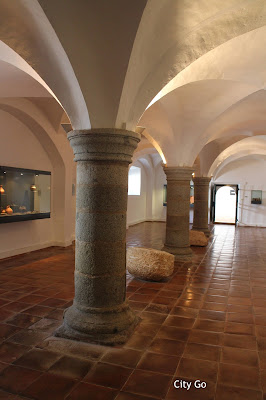
The archaeological museum was inaugurated in 1999 to house the findings from excavations in the region, mainly from the Roman Period. The collection also includes materials resulting from the restoration of local patrimony. Opening hours: Tue. 14h-17h (18h Jun. Sep.); Wed.-Sun. 10h to 13h and 14h to 17h  (18h Jun. Sep.) Entrance fee: €3 (includes castle and hunting museum)

Monastery Vidiani, Lassithi, Greece

Image
The Vidiani Monastery is located at the foot of Mount Loulodaki, in Lassithi Plateau. It was founded in the mid-19th century by monk Methodius on the ruins of a former monastery. The monastery was set to fire during the revolution of 1866 but was soon rebuilt. There you can find a small cafe and buy traditional natural products like oils and soap. It's the ideal place to make a small stop while exploring the Lassithi Plateau. How to go: The monastery is included in some bus excursions to Lassithi Plateau. Otherwise, you can reach the monastery by car, as public transport to Lassithi Plateau is scarce.

Lake Voulismeni, Agios Nikolaos, Greece

Image
Lake Voulismeni was a fresh water lake until 1870 when it was connected by a narrow channel to the old harbour. For many years it was believed that the lake was bottomless and according to legend goddess Athena used to bathe in it. In 1853 a British admiral found that it was about 60 m deep, which was confirmed by Jacques Costeau in 1976.  The lake is surrounded by many cafes and tavernas and if you're lucky you might even spot a loggerhead turtle .

The Venetian Shipyards, Heraklion, Greece

Image
Also known as the Venetian Arsenal, the Venetian Shipyards were an ambitious military project developed in four stages between the 15th and 17th centuries. A total of 19 shipyards were built, grouped in three complexes: the Antichi Arsenal, the Vechi Arsenal and the Nuovi Arsenal. In the 17th century, when Heraklion harbour took its final form, the arsenal was able to dock 50 galleys at a time. The shipyards were used for the construction and repair of ships of the at the time mighty fleet of the Republic of Venice. In the 1930s a significant part of the arsenal was destroyed to give way to the new harbour. Today only six shipyards, part of the Vechi and Nuovi arsenals, remain. Entrance free Heraklion

Church and Monastery of São Vicente de Fora, Lisbon, Portugal

Image
The Monastery of São Vicente de Fora was founded in 1147 by the first king of Portugal, D. Afonso Henriques, as a result of a vow the king made to the saint to recover Lisbon from the Moors. It was the first monastery to be built outside the city walls, so it was named "de fora" (outside). With time the Monastery decayed and by the mid-16th century, it was in risk of ruin. In 1580 Portugal lost its independence to Spain and, by the end of the century, King Philip II of Spain, I of Portugal decided to have both the church and the monastery rebuilt as a symbol of the new ruling dynasty. It is thought that the plans of the church and monastery were inspired by those of El Escorial, in Madrid. The church was consecrated in 1629. The canons, obeying the rule of Saint Augustin, lived in the monastery until 1834, date in which all religious orders were banished from Portugal. Saint Anthony of Lisbon (or Padua) took his vows in this church, before joining the then recently found...

Place des Vosges, Paris, France

Image
Place des Vosges is one of the most beautiful squares in Paris and also the oldest planned square in Paris. It was originally called Place Royale as it was planned by order of King Henri IV, in 1612. All buildings surrounding the square have the same design, with facades of red bricks and black slate roofs, all the same size except for the King's Pavillion and the Queen's Pavillion, on each side of the square, which are slightly taller. Despite this designation, Queen Anne of Austria, future wife of King Louis XIII,  was the only royal to live in one of the Pavillions (the Queen's), for a short time before her wedding. Cardinal Richelieu ordered a statue of King Louis XIII to be put in the middle of the square, but it was melted during the revolution. The statue that can be seen today is a copy from 1825. The square was renamed in 1799 when the Départment des Vosges (a mountainous region in France) became the first to pay taxes, supporting the Revolutionary Army. Th...