Posts

Showing posts with the label R

Rethymnon Old Town, Greece

Image
The Old town of Rethymnon combines the Oriental features of the Turkish Period with the Renaissance-style Venetian architecture. In 1571, during the Turkish siege- after which the Fortezza was built- most buildings of Gothic features were destroyed and most of the city had to be rebuilt in the fourth quarter of the 16th century. Building styles then changed during the Turkish occupation, when the dressed stone of the Venetians was replaced by the wooden frames of the Turkish. How to go: By bus from Heraklion ( KTEL ). What to see: Fortezza Harbour Lake Kournas Rimondi Fountain
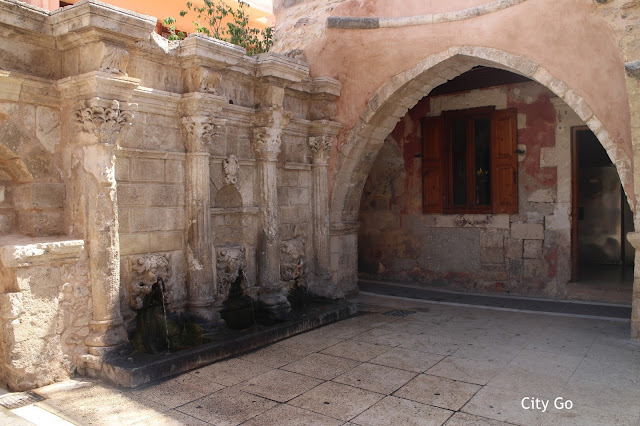
Rimondi Fountain, Rethymnon, Greece

Image
The Rimondi fountain started being built in 1626, by order of Venetian governor Rimondi, on site of a much older one, believed to have existed since at least 1588. The fountain was built to address the severe water shortages, common to all Cretan towns at the time. The additions made during Turkish times either fell into decay or were destroyed by the local inhabitants. The fountain includes four Corinthian columns and spouts in the shape of lion's heads. Back to Rethymnon

Roman bridge, Merida, Spain

Image
The Roman bridge in Merida is 792 metres long, one of the longest in the Roman world. It's supported by 70 consecutive arches. During the centuries the bridge has been damaged by floods- before the Guadiana river was regulated by dams and reservoirs- and by wars- the last one in 1811 when Wellington ordered the bridge to be blown up. Consequently, the bridge has been reconstructed in different time periods and although the material used is always the same- granite- the technical expertise has varied significantly. The vibration caused by traffic determined it to be closed to all traffic but pedestrian. Back to Merida

National Museum of Roman Art, Merida, Spain

Image
The National Museum of Roman Art was inaugurated on September 9, 1986, specifically to house the Roman findings in the city. The building resembles the splendour of the Roman monuments and it mirrors Roman construction through modern architectural concepts and techniques. It was built with bricks specially manufactured for the museum. One of the features of the museum is the use of natural light to illuminate the items on display. The museum is built on top of Roman remains of houses and roadways, which can also be visited, in the museum's crypt. The creation of the first archaeological museum dates back to 1838 but it had to be re-evaluated, particularly after major excavations in 1910 and in the 1960s significantly increased its collections. The church of Santa Clara, the original premises of the museum, still houses the Visigothic collection. Opening hours: 9.30 a.m. to 8 p.m. (6.30 p.m. Oct. to Mar.; 10 a.m. to 3 p.m. on Sun.; closed on Mon.) Entrance fee: ...

São Roque Museum, Lisbon, Portugal

Image
São Roque Museum is located in a former Jesuit "Casa Professa" (mother house). The 17th-century building was substantially remodelled in the late 19th, early 20th centuries. Inaugurated in 1905, the museum is one of the oldest religious art museums in Portugal. The collection is divided into five parts: The Hermitage of Saint Roque, the Society of Jesus, Oriental Art, the Treasury of the chapel of Saint John the Baptist and the Misericórdia de Lisboa. Opening hours: 10 a.m. to 6 p.m.; 2 p.m. to 6 p.m. on Mondays. Entrance fee: €2.5 Back to Lisbon

Praça da República, Tomar, Portugal

Image
Praça da República is the main square in Tomar and where the Town Hall and the Church of Saint John the Baptist are located. Both buildings were gifted to the city by D. Manuel I, King of Portugal and Grand Master of the Order of Christ (16th century). The statue in the centre belongs to D. Gualdim Pais, fourth Grand Master of the Knights Templar in Portugal and founder of the city, who ordered the construction of the castle , the Convent of the Christ and the church of Santa Maria do Olival, a burial ground for the knights templar. Back to Tomar

Mercado da Ribeira, Tavira, Portugal

Image
Tavira's old market was inaugurated in 1887 and was used as a market until 1999. It was then restored and remodelled to house a set of traditional shops and restaurants and to be used as a cultural centre. Opening hours: 9 a.m. to 11 p.m.

Roman Bridge, Tavira, Portugal

Image
The Roman bridge of Tavira, also known as the "old bridge" is either a 3rd-century Roman bridge restored in the Middle Ages or a bridge built on the site of a Roman bridge in the same period. For this reason, it is also sometimes called the "romanesque bridge". However, its current appearance results from renovations carried out in the 17th century. It was closed to traffic in 1989 when two pillars were destroyed during a flood and, although it was repaired by 1992, it remains a pedestrian bridge. How to go:   You can take bus  n. 67  from Faro to get to Tavira.