Posts

Showing posts with the label K

Kitroplatia, Agios Nikolaos, Greece

Image
The Beach of Kitroplatia is located in the small village of Agios Nikolaos. It has umbrellas, showers and a lifeguard. Nearby there are cafes and tavernas. It's named "Citron Square" after the citron trade, which flourished in Agios Nikolaos during the 19th and 20th centuries.

Knossos, Heraklion, Greece

Image
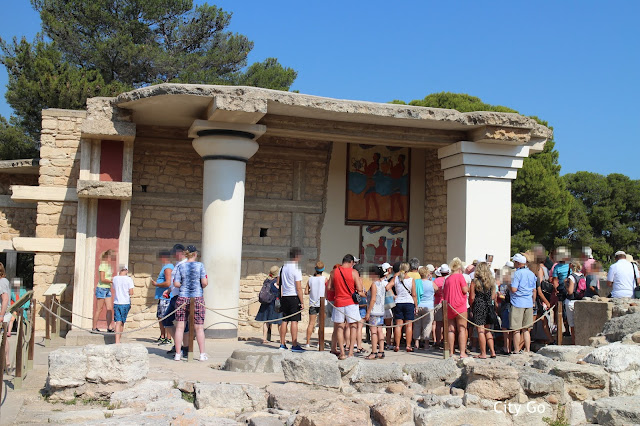
When excavations started, it had long been known that there once existed a city called Knossos. The first man to excavate the area, in 1878, was Minos Kalokairinos, a merchant from Heraklion and a lover of antiquity. However, the Turkish owners of the land compelled him to stop the excavations and the attempts of Schliemann (famous German archaeologist) to buy the land produced no results due to the high sums demanded. However, by 1900 the island had been declared an independent state and the Turkish decided to leave. Arthur Evans was able to buy the land and proceed with the excavations. By 1903 almost all the palace had been uncovered but Evans continued his research until 1931. During the excavations, part of the palace was restored and reinforced and the frescoes discovered were replaced by copies. The restoration methods used at Knossos have received much criticism and some of the conclusions reached by Evans have been questioned. The palace has been associated with the myt...

Keras Kardiotissas Monastery, Greece

Image
The Keras Kardiotissis Monastery is an Eastern Orthodox Monastery dedicated to the Virgin Mary, first mentioned in manuscripts in 1333. Its interest derives from the amazing 14th-century frescoes in the small church. It is built on the northern slopes of Mount Dikti, at an altitude of 650 meters. The monastery became renowned for its miracle-working Panagia Kardiotissa icon, which is said to have been stolen three times, and on the three times returned "on its own" to the monastery. On the third time, it was even tied to a column with chains, both of which can be seen in the monastery. It was successfully stolen a fourth time by a wine merchant and taken to Rome, where it's now enshrined in the church of St. Alphonsus. The icon was replaced by a copy dating from 1735 which is also regarded as miraculous. Opening hours: Closed on Mondays Entrance fee: €2 How to go: By car or an excursion to the Lassithi Plateau.

Koules Fortress, Heraklion, Greece

Image
The first fortress in Heraklion Harbour was probably built during Muslim rule, in the 9th or 10th centuries. When the Venetians conquered Crete, in 1204 they reinforced this fortress which, in 1303, was destroyed by an earthquake. It was subsequently repaired but in the 16th century, it was definitely dismantled to give way to new fortifications. The current fort was built between 1524 and 1540. It is decorated with marble relief decorations of the winged lion of Venice. During the 20th and 21st centuries, it has undergone extensive restoration. Opening hours: Tue.-Sun. 8.30 to 19.00 (15.00 from Nov. to Mar.) Entrance fee: €2 Heraklion

Kolokytha beach, Elounda, Greece

Image
Kolokytha is a small island opposite the Peninsula of Spinalonga, 12km from Agios Nikolaos and 3km from Elounda. It is a secluded cove with white sand and crystal clear water surrounded by olive groves, wheat crops and rocks. The beach is very small so if you want to avoid crowds brought in by excursions go early in the morning or late in the afternoon. How to go: Kolokytha beach is included in most Spinalonga island excursions; you can also reach it by car, which will take about 15m departing from Elounda.

Klementinum, Prague, Czech Republic

Image
The Klementinum was founded by the Jesuits in 1556. In 1653 they started expanding their premises and the works went on for 170 years. Due to this lag in time, there's a variety of styles in the Klementinum. Occupying over two hectares, it is also one of the largest buildings in Europe. The Jesuits ran a school since its foundation which was promoted to University in 1612 and merged with Charles University in 1654, along with the library. The Baroque Library was first opened in 1722 as part of the University. It houses over 20,000 volumes, mostly foreign theological literature. The interior of the library has remained intact since the 18th century. Also remarkable is the collection of astronomical and geographical globes in the centre of the library.  The Astronomical Tower was built in 1722 and is 68 metres tall. Construction of the tower was related to the development of astronomical studies in the country. However, the tower was not only used as an astronomical obser...

Kyrenia, Cyprus

Image
Kyrenia is a city in northern Cyprus. Evidence shows that it has been inhabited since 5800-3000 BC but it's traditionally accepted that the city was founded by the Achaeans after the Trojan War. By the late 4th, early 3rd century BC there was a lively maritime activity, evident in an ancient shipwreck discovered in 1965 and now exhibited in Kyrenia castle. During the Roman period, Kyrenia continued to be a populous and prosperous city and it was during this period that the first castle was built. With the division of the Roman Empire Kyrenia fell under the Bizantine rule. During the crusades, King Richard I of England became the master of the island but eventually sold it to Guy de Lusignan in order to get more funding for his crusade. Under Frankish rule, Kyrenia again became the commercial and administrative centre of the region. The castle was enlarged and walls and towers were built around the town. In 1489 Cyprus was conquered by the Venetians who remodelled the castl...