Posts

Showing posts with the label D

Dikteon Cave (Zeus Cave), Lassithi, Greece

Image
The Dikteon Cave is located near the village of Psychro, at an altitude of 1025 metres, on the northern slopes of Mount Dicte, which dominates de Lassithi Plateau. To reach the cave there's a steep path upwards of about 1 km, which you can do walking or riding a donkey (€5). In the cave, there's a trek down a steep set of stairs, 100 metres into the mountainside. As you walk into the cave the temperature drops several degrees. It consists of five chambers and at the bottom, there's a small lake surrounded by large stalactites and stalagmites. Behind this lake, there's a small chamber where according to legend Rhea gave birth to Zeus to protect him from his father, so for centuries this Cave was a place of worship and offers, where only a few could enter. Opening Hours: 8 a.m. to 8 p.m. (3 p.m. Nov.-Mar.) Entrance fee: €6 How to go:   Public transports to the Lassithi Plateau are scarce, so the best way to go is either by car or on an excursion. ...
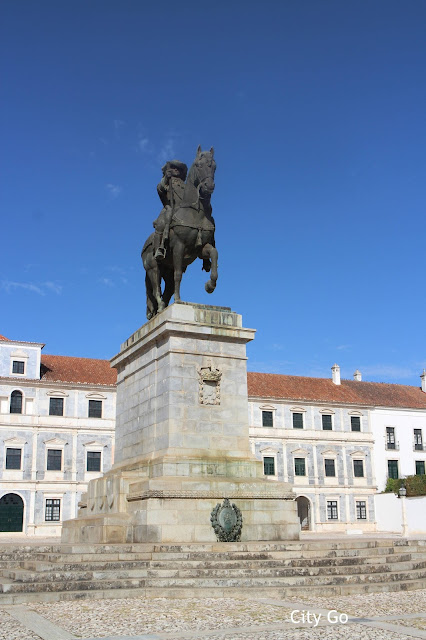
Ducal Palace of Vila Viçosa, Portugal

Image
The Ducal Palace of Vila Viçosa was built in the early 16th century, by the fourth Duke of Bragança, D. Jaime. The Dukes of Bragança, originally from this city (Bragança) in Northern Portugal, relocated to Vila Viçosa in the 15th century. They moved to the castle on the hilltop but by the early 16th century D. Jaime, the 4th Duke of Bragança, decided he had had enough with the discomfort of living in a medieval castle and decided to have a Palace built. However, the works that gave the Palace its grandeur and mannerist style that can be seen today, were only carried out in the 16th and 17th centuries. The Palace raised in importance when, in 1640 the 8th Duke of Bragança became the King of Portugal, D, João IV. Much of the finest furniture was taken to Lisbon at this time- and later to Brazil, when the royal family fled the French Invasions- but there are still many pieces of interest to be seen. The Palace continued to be a place of relaxation and leisure, particularly for the ki...

Dom Toren, Utrecht, Netherlands

Image
The Dom tower started being built in 1321, as part of the Gothic Dom church; it was concluded in 1382. At the time it symbolised the Bishop's secular and ecclesiastical power. In the beginning of the 16th century, the tower gained its first 13 bells. They each have their own name and weigh about 30.000 kilos. Later, in 1164, another 35 bells were added. On the 1st of August 1674, the town of Utrecht was hit by a tornado which destroyed part of the Dom church, permanently separating the tower from the church. The damages and rubble were only addressed 150 years later; during the 19th and 20th centuries, the tower was renovated a few times. Today, at 112 m and 32 cm, the Dom Tower is the tallest tower in the Netherlands and continues to be the pride of Utrecht. Opening hours: Sunday and Monday 12 pm to 5 pm; Saturday and Tuesday 10 am to 5 pm.  Entrance fee: €9. You can buy your ticket online  here . Back to Utrecht

Dom Under, Utrecht, Netherlands

Image
Utrecht dates from 45 AD when the Romans built the castellum Trajectum, a defensive fortress in the northern border of the empire. In the Dom Under you can see excavations showing different periods of the city's history, from its beginnings as a Roman fortress. Opening hours: There are guided tours, from Tuesday to Sunday, every hour from 10.30 to 16.30. Until 19.30 on Tuesdays and Thursdays. The visit takes about 75 minutes and is not recommended for children under 8 years old. Entrance fee: €11 (book online here ) Back to Utrecht

Dubrovnik, Croatia

Image
Dubrovnik dates back to prehistoric times when it was a small settlement located on an island known as Laus, separated from the mainland by a marsh. Laus changed to Raus which in turn became Ragusa, the name the city went by when people from surrounding communities flee there for protection from the Slavs, in the 7th century. It expanded considerably as part of the Byzantine Empire and by the 13th century the Republic of Venice, considering the city to be a threat, conquered it and then controlled it from 1205 to 1358. The Old Town was concluded in the 13th century and remains almost unchanged to the present day. In the 14th century, Dubrovnik became Croat-Hungarian but with significant autonomy. The city was hit by an earthquake in 1667 and, although the walls remained standing, it was weakened and was easily conquered by Napolean in the beginning of the 19th century. The Republic of Ragusa was officially dissolved and, with Napolean's fall, incorporated in the Austro-Hunga...