Posts

Showing posts with the label Bruges

Bruges, Belgium

Image
The first fortifications were built during Roman times to protect the coastal area from pirates. After the decline of the Roman Empire, in the 4th century, the Franks took over the whole region.  The city is first mentioned in records, in the 9th century, as "Bruggas", a word that probably comes from the old Dutch, meaning bridge. In this century, Baldwin I of Flanders reinforced the Roman fortifications to protect the city from Viking attacks. The city quickly became an important international trading port but in the 12th century, the river Zwin started to silt up. Bruges adapted by building outports in Damme and Sluis after a storm created natural channel connecting the Zwin to the sea, and by taking advantage of its strategic location at the crossroads of the northern Hanseatic League and the southern trade routes. The city became the capital of the County of Flanders in 1089 and received its charter in 1128. By the 14th century Bruges was the warehouse ...

Bruges Belfry and the Cloth Hall, Belgium

Image
The Belfry tower is 83 metres tall and it takes 366 steps to reach the top and enjoy the panoramic view, even on a stormy day like the one on which I visited. The Belfry was built in the 13th century as part of a complex of halls that were used as warehouses and a market. The octagonal lantern tower made out of sand-lime brick was added in the 15th century. The belfries were a symbol of the cities' power and confidence and are amongst the first examples of civilian and public architecture. They served as an observation post for spotting fires and other dangers. The Belfry of Bruges houses a carillon with 47 bells weighing a total of 27.5 tonnes. The carillon was added in the 16th century. Also noteworthy are the iron gates in the old treasury where all important documents were kept in the Middle Ages. Opening hours: 9.30 am to 6 pm. Closed on Jan. 1 and Dec. 25. Entrance fee: €10 Back to Bruges

Sint Janshospital, Bruges, Belgium

Image
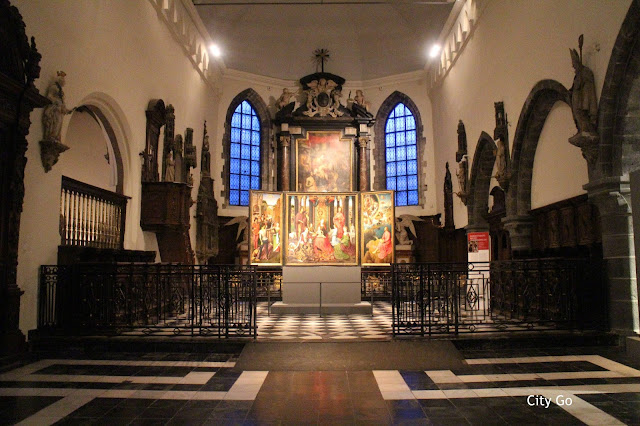
Saint John's Hospital in Bruges is one of the oldest preserved hospital buildings in the world. It was built in the 12th century and was active until 1978. It grew during the Middle Ages and it was the place were the sick, pilgrims and travellers were cared for by nuns and monks. The museum displays several medical instruments and furniture but it's better known for six masterpieces of the 16th-century artist Hans Memling, including a shrine of Saint Ursula painted specifically for Saint John's. Unfortunately, the medical display can sometimes be cleared to give way to temporary exhibitions of modern art, which was the case the day I visited. Opening hours: 9.30 am to 5 pm Entrance fee: €8 Back to Bruges

Grote Markt, Bruges, Belgium

Image
The square has been used as a marketplace since 958, with weekly markets since 985. Currently, the market takes place on Wednesday mornings and it's possible to buy fresh fruits and vegetables, meat and cheeses. It opens from 8 a.m. to 1 p.m. It's also the venue of the Christmas market , in December. The most prominent building in the square is the Belfry and the Cloth Hall, while the oldest house is the 15th-century Bouckhoute house. The colourful houses, with restaurants and cafes, used to be guild houses. The Provinciaal Hof building, on the eastern side, built in the 19th century is relatively recent. Right beside it is located the multimedia experience "Historium", which lasts for about an hour. At the centre of the square are the statues of Jan Breydel and Pieter de Coninck, erected in 1887. They were the leaders of the "Bruges Matins/ Brugse Metten", a violent uprising against Phillip the Fair in 1302. Back to Bruges

Onze Lieve Vrouwekerk, Bruges, Belgium

Image
The Onze Lieve Vrouwekerk (Church of Our Lady) and the 125-metre brick steeple dominating the skyline of Bruges were built between the 13th and 15th centuries. The tower is the tallest structure in the city and the second tallest brickwork tower in the world. The church houses a number of magnificent pieces of art and woodworks, like the Carrara marble Madonna and Child sculpture by Michelangelo, probably meant for Siena cathedral but brought to Bruges in 1504. The ceremonial tomb of Mary of Burgundy is an example of late Gothic style while her father's, Charles the Bold, tomb was only completed in the mid 16th century, in an early Renaissance style, after his remains were brought to Bruges. Also noteworthy are the painted medieval tombs from the 14th century. Opening hours: 9.30 a.m. to 5 p.m. (1.30 p.m. to 5 p.m. on Mondays) Entrance fee: €4 Back to Bruges